For most people, artificial intelligence is still associated primarily with productivity: automating a task, summarizing information, analyzing data, or making some existing process more efficient. Over the past year, however, I have become increasingly interested in another possibility. What happens when AI is approached not simply as a tool for accomplishing work, but as a medium for exploring an idea?
For me, that exploration has largely taken place through images.
And the more I have worked with generative tools, the more I have become interested in what happens before an image appears on the screen.
Before the Prompt
Every image begins somewhere.
Sometimes it is a scene from literature or mythology. Sometimes it is a historical period, a fragment of poetry, or an atmosphere I want to make visible. From there come questions of composition, symbolism, artistic tradition, color, light, and mood. I look at references. I research visual traditions. I consider how other artists have approached similar subjects.
Only then does prompting begin.
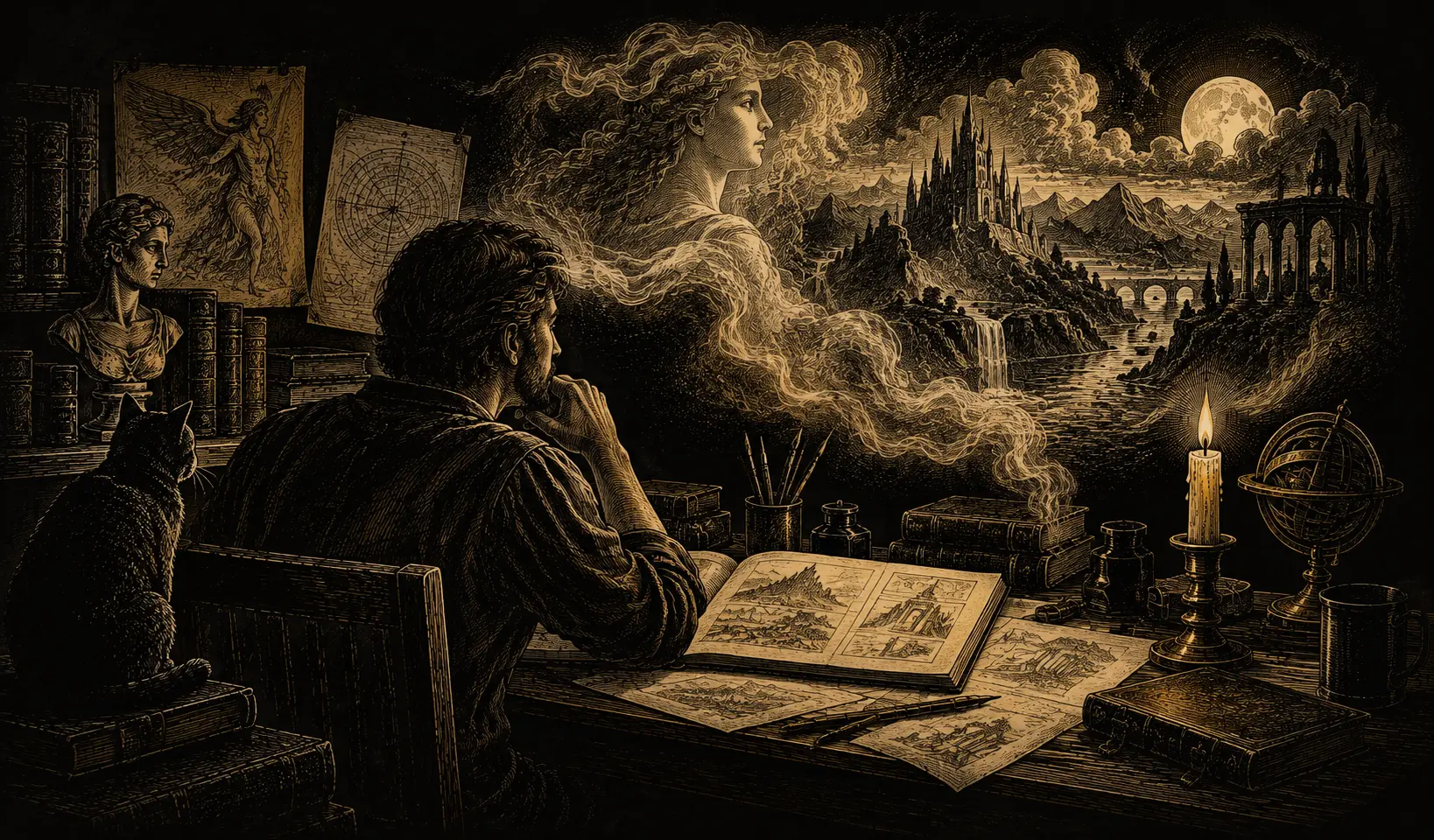
This is what I think of as the image before the image: the imagined work that exists before the generative system produces anything at all.
The prompt is certainly part of the creative process, but it is not the beginning of it. Nor is a generated image necessarily the end. Results are rejected, revised, and regenerated. Composition changes. Lighting changes. Details disappear or emerge. Sometimes an unexpected result suggests an entirely different direction.
Gradually, something imagined becomes something visible.
Where Does the Creative Act Happen?
Sharing some of this work publicly has exposed me to a useful criticism. If a generative model is mathematically producing an image from statistical relationships learned during training, can the person using it really claim to have made the creative decisions behind the result?
The first part is straightforward: the model generates the pixels. It does not simply retrieve an intact image from my imagination and place it on the screen.
But that leads to a question I find more interesting: where does the creative act actually reside?
Before generation, someone has decided what should be depicted and why. Galahad should stand before the Grail. The encounter should feel visionary rather than literal. The light should seem supernatural rather than natural. The composition should suggest revelation rather than adventure.
After generation, judgments continue. One result feels too theatrical. Another is visually impressive but misses the emotional register entirely. A third contains an unexpected detail worth developing. Each iteration becomes part of a process of bringing the visible image closer to—or sometimes deliberately farther from—the image that existed before it.
This does not mean that every AI-generated image represents a significant creative achievement. Typing a few words into a generator and accepting the first result requires relatively little involvement. But that may tell us less about AI itself than about the range of ways people can engage with any medium.
A camera can record a casual snapshot or become part of an elaborate photographic practice. The existence of the former does not make the latter impossible.
Intention Meets Emergence
There is, however, a complication.
I once described my AI-assisted work by saying that every creative decision, from concept to composition to refinement, was intentional. I would state that more carefully now.
Generative systems introduce variation and unpredictability. I can describe the composition I want in considerable detail and still receive something I did not anticipate. The model contributes possibilities that were not consciously designed by me.
That does not eliminate human intention. It changes the way intention operates.
The process becomes a negotiation between what was imagined beforehand and what emerges during creation. I direct, evaluate, reject, retain, and refine, but I do not control every pixel. Occasionally the system produces something unexpected that changes my conception of the work itself.
This is one reason I find AI more interesting as a creative medium than the metaphor of a "vending machine" suggests. I rarely know precisely what the final image will look like when I begin. There is an image before the image, but it is not a blueprint. It is closer to an intention—a sense of what the work should communicate and how it should feel.
The finished piece develops through the encounter between that intention and the possibilities the medium presents.
The Question of Influence
The idea of an image existing before its execution also raises a more difficult question: where do our imagined images come from?
Mine are deeply shaped by things I have encountered elsewhere—mythology, history, poetry, fantasy literature, classical painting, engraving, cinema, and generations of visual storytelling. None of us imagines from a cultural vacuum.
With generative AI, however, this question takes on particular ethical significance because the system's own visual capabilities are derived from training data.
Concerns about copyright, attribution, environmental cost, and the livelihoods of working artists should not be dismissed as simple resistance to technological change. They are legitimate questions, and some remain unresolved. I am particularly cautious about using the names of living artists as shortcuts for producing recognizable styles. My own interest is more often in broader traditions and visual languages—Romanticism, Symbolism, illuminated printing, classical painting, engraving—and in asking what those traditions might contribute to a particular subject.
Human artistic influence and machine training are not equivalent processes. Treating them as though they were risks overlooking important ethical and technical distinctions.
Yet both invite us to consider the relationship between creativity and inheritance.
Artists have always worked within traditions. They study composition, encounter the work of predecessors, adopt conventions, reject others, and combine influences into new forms. The image before the image is therefore never entirely ours. It carries traces of things we have read, seen, studied, remembered, and sometimes forgotten.
AI makes that old creative condition newly visible—and considerably more complicated.
Making the Imagined Visible
Perhaps this is ultimately what interests me most about AI-assisted creation.
It allows someone with an image in the mind's eye to enter into the process of making that image visible, even without the technical ability to paint it in oils, engrave it into copper, or construct it digitally by hand.
That does not make those skills less valuable. My experience has been almost the opposite. The more closely I study composition, lighting, printmaking, painting, and visual history in order to guide generative systems, the more conscious I become of how much knowledge resides within the work of accomplished artists.
Nor do I think AI removes the need for judgment. If anything, the abundance of possible outputs makes judgment increasingly important. The system can produce images almost endlessly. It cannot tell me which one expresses what I meant to express.
That remains a human question.
The Image Before the Image
For this reason, I am hesitant to describe AI-assisted creation as either the democratization of art or the destruction of it. Both conclusions seem too certain for a medium whose conventions, ethics, and creative practices are still being negotiated.
I find it more useful to return to the moment before generation and ask:
What am I actually trying to make visible?
The answer might begin with a medieval legend, a line of poetry, an old engraving, a remembered landscape, or an image that exists nowhere except in imagination. Technology enters afterward. It gives that idea a way to take form, sometimes imperfectly and sometimes unexpectedly.
Human judgment remains necessary throughout: to direct, interpret, reject, refine, and ultimately decide whether what appeared on the screen bears any meaningful relationship to what prompted its creation.
That relationship between imagination and artifact may be where the most interesting questions about AI-assisted creativity reside.
Because before there are pixels, there is intention.
Before there is a prompt, there is an idea.
And before there is the image we can see, there is the image we are trying to find.